Global oil markets have once again become a major concern for manufacturers, importers and textile buyers.
In early September 2026, Brent crude oil moved back above the psychologically important level of USD 100 per barrel, driven largely by renewed geopolitical tensions in the Middle East and concerns over disruptions to energy supply and shipping routes. Reuters reported that Brent had risen by approximately 25% since early August as uncertainty surrounding regional energy infrastructure and the Strait of Hormuz intensified.
For polyester fabric buyers, however, the important question is not simply:
“Is crude oil becoming more expensive?”
The more useful question is:
“How could prolonged energy volatility affect polyester raw materials, fabric production, freight costs and future purchasing decisions?”
As a manufacturer of polyester fleece fabrics and blankets, we believe buyers should look at the issue as a supply-chain risk rather than react to a single day’s oil price movement.

Why Oil Prices Matter to Polyester Textiles
Polyester does not come directly from crude oil, but it is part of the wider petrochemical value chain.
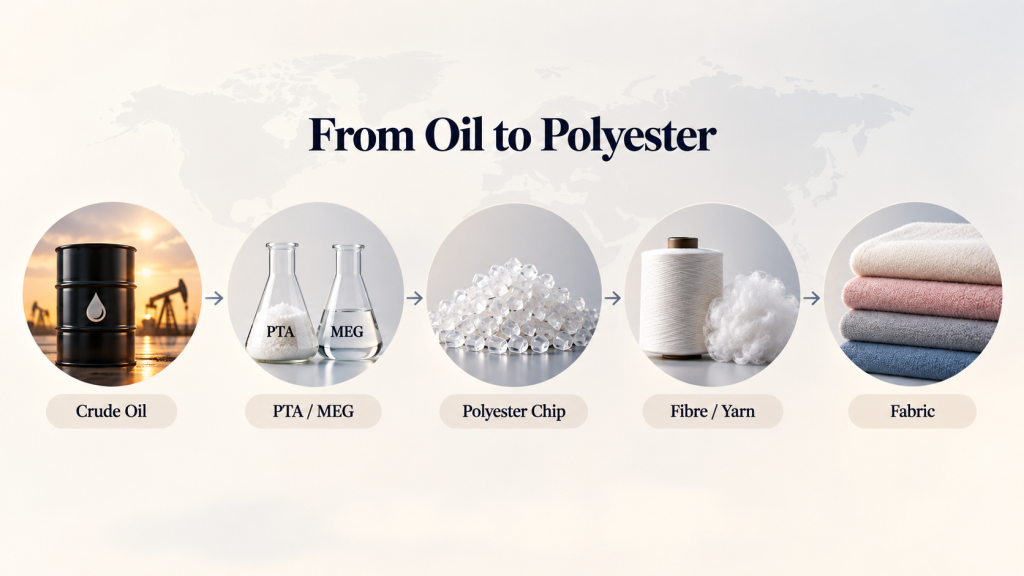
The production chain for conventional polyester textiles involves several stages, from petrochemical feedstocks through intermediate chemicals and polyester polymerisation, before the material eventually becomes fibre, yarn and fabric.
This means changes in crude oil prices can influence the textile industry, but the transmission is not immediate or one-to-one.
A 20% increase in crude oil does not mean polyester fabric prices will automatically increase by 20%.
Actual fabric costs are influenced by many factors, including:
- PTA and MEG market prices
- polyester chip, fibre and filament prices
- electricity, steam and natural gas costs
- dyeing and finishing expenses
- labour and production utilisation
- packaging and inland transportation
- ocean freight and insurance
- currency movements
- seasonal textile demand
Nevertheless, when crude oil remains elevated for a sustained period, cost pressure can gradually move downstream into petrochemicals, polyester raw materials, manufacturing and logistics.
The International Energy Agency has long recognised the close connection between oil markets and petrochemical industries. Its analysis shows that a significant share of industrial oil demand is associated with chemical feedstocks, highlighting why energy-market disruptions can eventually affect downstream manufacturing sectors.
The Current Situation Is About More Than Oil Prices
The latest energy shock is particularly important because it is happening together with disruption in one of the world’s most important shipping corridors.
According to the International Energy Agency, approximately 15 million barrels of crude oil and 5 million barrels of oil products normally pass through the Strait of Hormuz each day, equivalent to around one-fifth of global oil consumption. Recent disruption has dramatically reduced these flows.
Shipping data reported by Reuters on September 10 also showed commodity vessel traffic through the Strait falling into single digits on the previous day.
This matters to textile buyers because supply-chain risk does not stop at the oil refinery.
Higher geopolitical risk may affect:
Fuel costs → vessel operating costs → freight rates → insurance → routing decisions → delivery reliability.
As a result, even textile products manufactured far away from the Middle East can indirectly experience additional logistics pressure.

What the Latest Oil Data Tells Buyers
The International Energy Agency’s August 2026 Oil Market Report described an unusually disrupted global oil market.
The IEA reported that global observed oil inventories had fallen substantially since the beginning of the conflict and projected global oil supply to decline on average in 2026, largely because of reduced Middle Eastern and Russian supply.
It also noted exceptionally wide movements in benchmark crude prices during July, illustrating how sensitive the market has become to geopolitical developments.
At the same time, OPEC+ decided on September 6 to maintain September production requirements into October rather than introduce another immediate production increase. The group is expected to continue reviewing market conditions monthly.
For textile buyers, these developments do not necessarily mean that polyester fabric prices must rise continuously.
They do mean that cost visibility is currently lower than usual.
That distinction is important.
What Could Happen to Polyester Fabric Prices?
From a manufacturer’s perspective, there are several possible scenarios.
1. Oil Prices Fall Back Quickly
If geopolitical tensions ease and shipping conditions normalise, part of the current oil-price premium may disappear.
In this case, polyester raw-material prices may experience relatively limited long-term impact.
Buyers should therefore avoid making purchasing decisions based solely on one or two days of energy-market movement.
2. Oil Remains Around Current High Levels
If crude prices remain elevated for several weeks or months, upstream petrochemical producers may face greater cost pressure.
This can gradually influence polyester feedstocks, fibre and yarn pricing.
At the fabric manufacturing level, the effect could appear through higher raw-material quotations, dyeing costs, utilities and transportation expenses.
3. Shipping Disruption Becomes More Serious
For international buyers, this could be as important as the raw-material issue itself.
Even if polyester yarn prices remain relatively stable, freight, insurance, vessel availability or longer shipping routes could increase the total landed cost of fabric.
Therefore, buyers should evaluate not only the FOB fabric price, but the complete sourcing cost and delivery risk.

Five Questions Polyester Fabric Buyers Should Ask Their Suppliers
During periods of market volatility, buying at the lowest quoted price is not always the same as achieving the lowest sourcing cost.
We recommend that buyers discuss the following questions with their suppliers before confirming large or time-sensitive orders.
1. How long is the current quotation valid?
When raw-material markets move quickly, quotation validity may become shorter. Buyers should confirm the validity period rather than assuming the price will remain unchanged for several weeks.
2. Has the raw material already been secured?
For repeat orders or large-volume programmes, understanding whether the supplier has secured yarn or raw material can help buyers evaluate pricing and delivery certainty.
3. What is the realistic production lead time?
When buyers bring orders forward simultaneously, production schedules can tighten even before raw-material shortages actually occur.
A realistic production schedule is therefore more useful than an unusually aggressive promised delivery date.
4. Are freight costs included or subject to adjustment?
CIF buyers in particular should confirm how long ocean freight quotations remain valid.
In volatile shipping markets, fabric prices may remain unchanged while freight costs change considerably.
5. Can specifications remain consistent across repeat orders?
During raw-material volatility, buyers should pay particular attention to GSM, width, colour, hand feel and finished fabric consistency.
Saving a small amount on purchasing price is rarely worthwhile if inconsistent production creates problems later in cutting, sewing, finishing or retail.
Why Some Buyers Are Purchasing Earlier
The current market is already influencing purchasing behaviour beyond the textile industry.
Reuters recently reported that the Port of Los Angeles recorded exceptionally strong container volumes as U.S. retailers brought holiday merchandise into the country earlier than usual.
Among the reasons cited were concerns about tariffs, higher fuel costs and potential shipping disruption.
This does not mean every textile buyer should immediately increase inventory.
For many businesses, maintaining unnecessarily high stock creates its own financial risk.
Instead, buyers may consider a more balanced approach:
forecast important requirements earlier, secure critical programmes first, maintain communication with suppliers and leave sufficient production and shipping time.
This is particularly relevant for seasonal products such as fleece fabrics, winter blankets, plush fabrics and other cold-weather textile products.
Our View as a Polyester Fabric Manufacturer
At Kingcason, we manufacture polyester fleece and plush fabrics including flannel fleece, polar fleece, PV fleece, faux fur fabrics and related blanket materials.
From the production side, we believe the most important response to the current oil-market uncertainty is not panic buying.
It is better planning.
Professional buyers should distinguish between short-term market noise and changes that genuinely affect production costs.
Manufacturers, meanwhile, have a responsibility to communicate clearly when raw-material, energy or logistics conditions change rather than using market volatility simply as a reason to push customers into placing orders.
For customers with confirmed seasonal programmes or relatively predictable requirements, earlier planning can provide more room to manage:
raw-material purchasing, colour approval, production capacity, quality control, shipment schedules and unexpected logistics delays.
For customers whose demand remains uncertain, splitting purchases into planned batches may sometimes be more sensible than building excessive inventory.
Every sourcing programme is different.
The correct purchasing strategy should depend on product specifications, order volume, sales season, destination market and acceptable inventory risk.
Price Stability May Matter More Than the Lowest Price
Periods of volatility often highlight an important principle in textile sourcing:
A reliable fabric price is more valuable than an unrealistically low initial quotation that cannot be maintained.
For a professional buyer, the real cost of fabric includes more than the price per kilogram or metre.
Late shipments, shade differences, inconsistent GSM, width variation, production delays and emergency freight can all create costs far greater than a small difference in the original fabric quotation.
This is why supplier evaluation should consider:
price + consistency + lead time + communication + supply reliability.
Oil prices may rise or fall again over the coming weeks.
No responsible supplier can predict the market with certainty.
What manufacturers can do is monitor raw-material markets, communicate changes transparently and help buyers leave enough time to make informed purchasing decisions.
Final Thoughts
Oil above USD 100 per barrel is an important signal for the global economy, but polyester fabric buyers should avoid drawing overly simple conclusions from it.
The most realistic concern is not that every fabric price will suddenly surge.
The greater issue is that prolonged instability can introduce uncertainty across several parts of the textile supply chain at the same time:
petrochemical feedstocks, polyester raw materials, energy, transportation and international shipping.
For buyers preparing autumn and winter orders, the coming weeks may therefore be a good time to review forecasts, discuss quotation validity with suppliers and confirm critical production schedules earlier.
At Kingcason, our approach is simple:
provide buyers with transparent information, realistic lead times and stable manufacturing wherever possible — especially when the external market becomes less predictable.
Because in an uncertain market, good sourcing is not about predicting every price movement.
It is about being prepared for more than one possible outcome.